Property Explainers
What Is ABSD? Additional Buyer's Stamp Duty, Explained Simply
2 min read
Parliament lowered the en bloc consent threshold for condos aged 40 and above, but made collective sales harder to start. What changed, who it affects, and what owners and buyers should do.

Licensed real estate salesperson · CEA Reg. No. R059523G
Parliament passed the Land Titles (Strata) (Amendment) Bill on 8 September 2026, cutting the en bloc consent threshold for condos aged 40 and above for the first time since the regime began in 1999. The new rules are not in force yet. They start on a date the Minister will gazette.
If you own a unit in an older estate, the headline sounds simple: fewer signatures needed. The fine print is less simple. The same law makes it harder to start a collective sale, halves the time to collect signatures, and lengthens the wait after a failed attempt.
Here is what changed, who it affects today, and what I would do about it as an owner or a buyer.
The consent threshold now depends on how old the development is. Estates under 40 years old see no change.
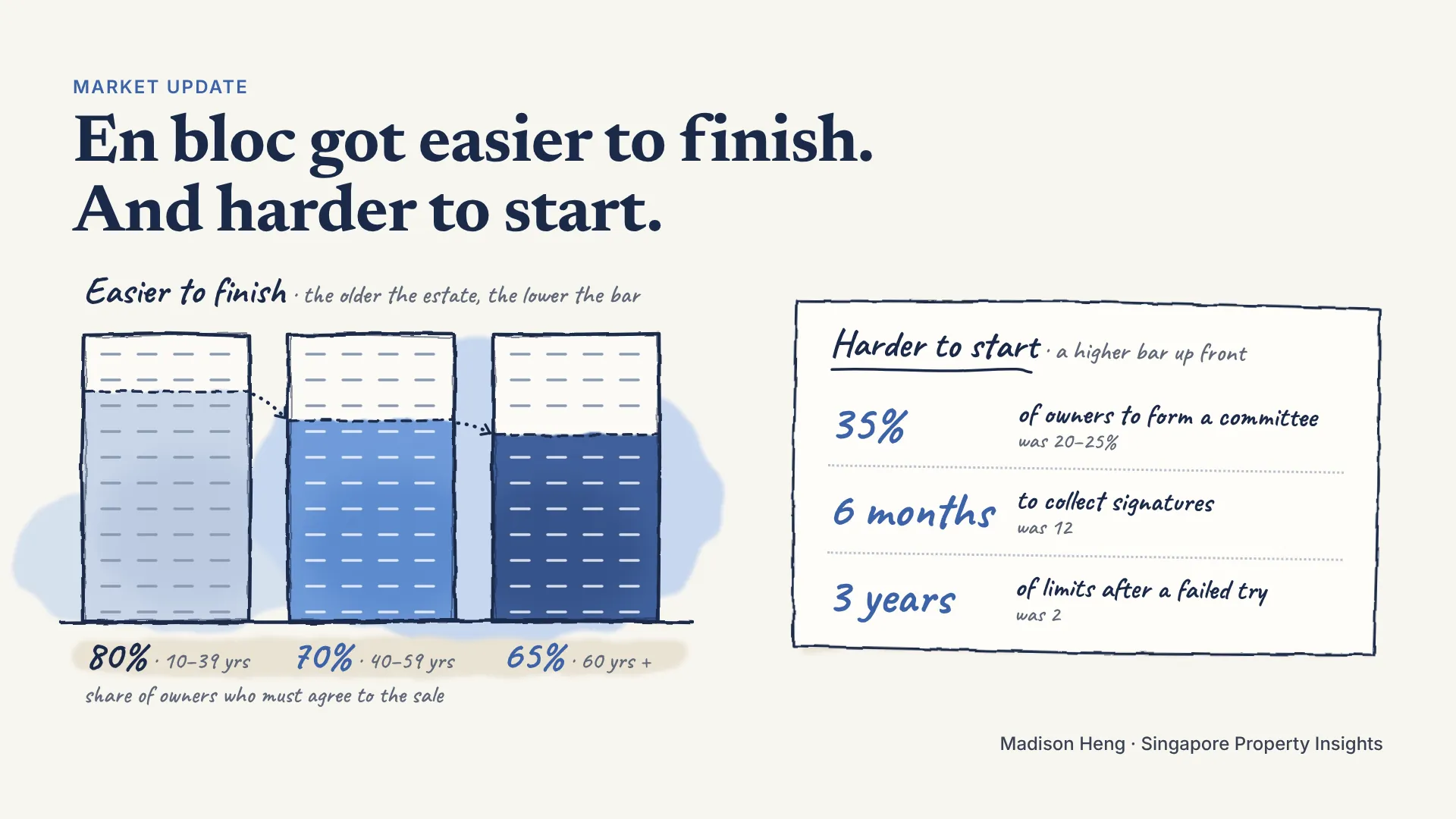
| Age of development | Before | After |
|---|---|---|
| Less than 10 years | 90% | 90% |
| 10 to 39 years | 80% | 80% |
| 40 to 59 years | 80% | 70% |
| 60 years and older | 80% | 65% |
Consent is measured by share value and strata area, not a simple headcount of units. As a rough guide, a 500-unit estate with equal shares needed about 400 owners on board under the old rule. At 70% it needs about 350, and at 65% about 325.
The process around the vote changed too.
| Step | Before | After |
|---|---|---|
| Support needed to call the meeting that forms a collective sale committee | 20% by share value or 25% by number of units | 35% by share value or number of units |
| Time to collect signatures on the collective sale agreement | 12 months | 6 months |
| Restriction after a failed attempt | 2 years | 3 years |
The law also extends majority-consent collective sales to certain non-strata developments, where owners hold long leases on their flats but not the land. Until now these needed unanimous agreement.
The lower threshold is only half the law. The other half protects owners who do not want to sell, and it changes how an en bloc campaign has to be run.
The Ministry of Law frames this as a package. Older estates get a practical route to redevelopment where support is broad, and estates without that support are spared repeated, drawn-out attempts.
The six-month window is the most contested part of the reform. Industry stakeholders broadly welcomed the changes when they were proposed in August, but some told The Straits Times that six months is too short to secure a mandate.
The worry is practical. A committee in a large estate has to brief hundreds of owners, answer questions on reserve price and apportionment, and chase signatures from owners who are overseas, elderly or holding units through estates and trusts. Halving the time raises the odds of a rushed campaign near the deadline.
The Government's answer is that long campaigns are the problem, not the solution. During the Second Reading on 8 September, several MPs raised the same concern for large estates. Law Minister Edwin Tong replied that most signatures typically come in within the first four months, and that longer campaigns tend to add pressure on holdouts, as reported from the debate.
My read: six months works if the homework is done before the clock starts. Committees will need the valuation, the reserve price logic and the method of apportionment settled early, because there is no longer a second half of the year to fix a weak start.
Fewer estates than the headlines suggest. About 20,000 private non-landed units sit in developments older than 40 years, against more than 360,000 in developments under 40, based on figures cited in Parliament.
The pool is even thinner among the big estates. SRI Research, writing in EdgeProp, counted 71 condos with at least 700 units. Only four are aged 40 to 59: Bayshore Park, Mandarin Gardens, Braddell View and Neptune Court, with 3,758 units between them. None has reached 60.
So the 65% tier has no large estate to apply to yet, and the 70% tier reaches four. The bigger effect comes later. SRI counts 33 large estates aged 10 to 39 with 29,420 units, and each will cross the 40-year line in time.
Smaller and mid-sized older developments are where I expect activity first. They have fewer owners to align, lower land quantum for a developer to fund, and some have already made repeated attempts.
Owner consent is only one side of a deal. A developer still has to pay the price, and on large sites the Additional Buyer's Stamp Duty (ABSD) clock has been a major deterrent.
That was eased on 28 July 2026, a week before the Bill was tabled. For qualifying en bloc sites bought from 29 July:
| Units in the new project | Time to complete and sell all units | Condition |
|---|---|---|
| 700 to 1,399 | 6 years, up from 5.5 | New project must yield at least 1.5 times the existing unit count |
| 1,400 or more | 7 years | Same 1.5 times rule, and at least half the units sold by end of year 6 |
The two policies do not line up neatly. One looks at how old your estate is, the other at how many homes the developer will build on it. An estate can qualify for one and not the other.
Even with more time, developers will weigh land price, land betterment charges, construction and financing costs, and the option of bidding for Government Land Sales sites instead. A lower threshold gets a site to tender. It does not get it sold.
Your odds improved, but the work moved to the front. You need 35% of owners just to form a committee, then six months to reach 70% or 65%. Sound out your neighbours and agree on a realistic reserve price before anyone calls a meeting. A failed attempt now costs the estate three years.
A minority of just over 20% could block a sale before. Once the rules start, it takes more than 30% in a 40 to 59 year old estate, and more than 35% in one aged 60 and above. The Strata Titles Board process and your right to object remain, and the campaign period is shorter. Know your numbers: what the proceeds would be, and what a comparable replacement home costs today after stamp duties and moving costs.
The old rules apply if the first signature on the collective sale agreement is collected before the commencement date. For estates aged 40 and above that are still collecting, the committee may call a general meeting to end the existing agreement and restart under the new rules. It then has seven months from commencement to reach the new threshold.
Do not pay for an en bloc that has not happened. A lower threshold raises the chance of a sale, not the certainty or the timing. Buy only if you would be content holding the unit for the next decade with no collective sale, at today's price and lease. Treat any collective sale as a bonus.
Fewer signatures are needed, but a sale still needs a buyer at the owners' price. The reform removes one obstacle for ageing estates and leaves the hardest one in place: owners and developers agreeing on a number.
I do not expect a repeat of the 2017 to 2018 en bloc wave. I expect more older estates to test the market once the rules commence, a handful of well-located sites with realistic reserve prices to sell, and many more to find that 70% of owners agreeing is not the same as a developer agreeing.
The commencement date has not been announced. Until it is, the 80% threshold and the 12-month window still apply.
This article is general information, not legal or financial advice. Owners in an active collective sale should consult the lawyers appointed for their estate.
Last updated 9 October 2026Based on publicly available Singapore property data
Sources & where to verify
Rules, rates and published figures change. Check the current position on the official source before you act on anything here.
New insights, when they're worth sending
Occasional emails when I publish something useful. No listings, no blasts.
Where most people go next from here.
I'd like to measure which articles are actually useful, using Google Analytics and a Meta advertising pixel. Nothing is loaded until you choose, and declining costs you nothing on this site. What these do.