Upgrading
How Much Cash Do I Actually Need To Upgrade To A Condo?
5 min read
The same question whether you own an HDB flat, an EC or a condo. It depends on your cash position, financing capacity, CPF usage and ABSD exposure — and whether you could genuinely carry both properties if the sale took longer than expected.

Licensed real estate salesperson · CEA Reg. No. R059523G
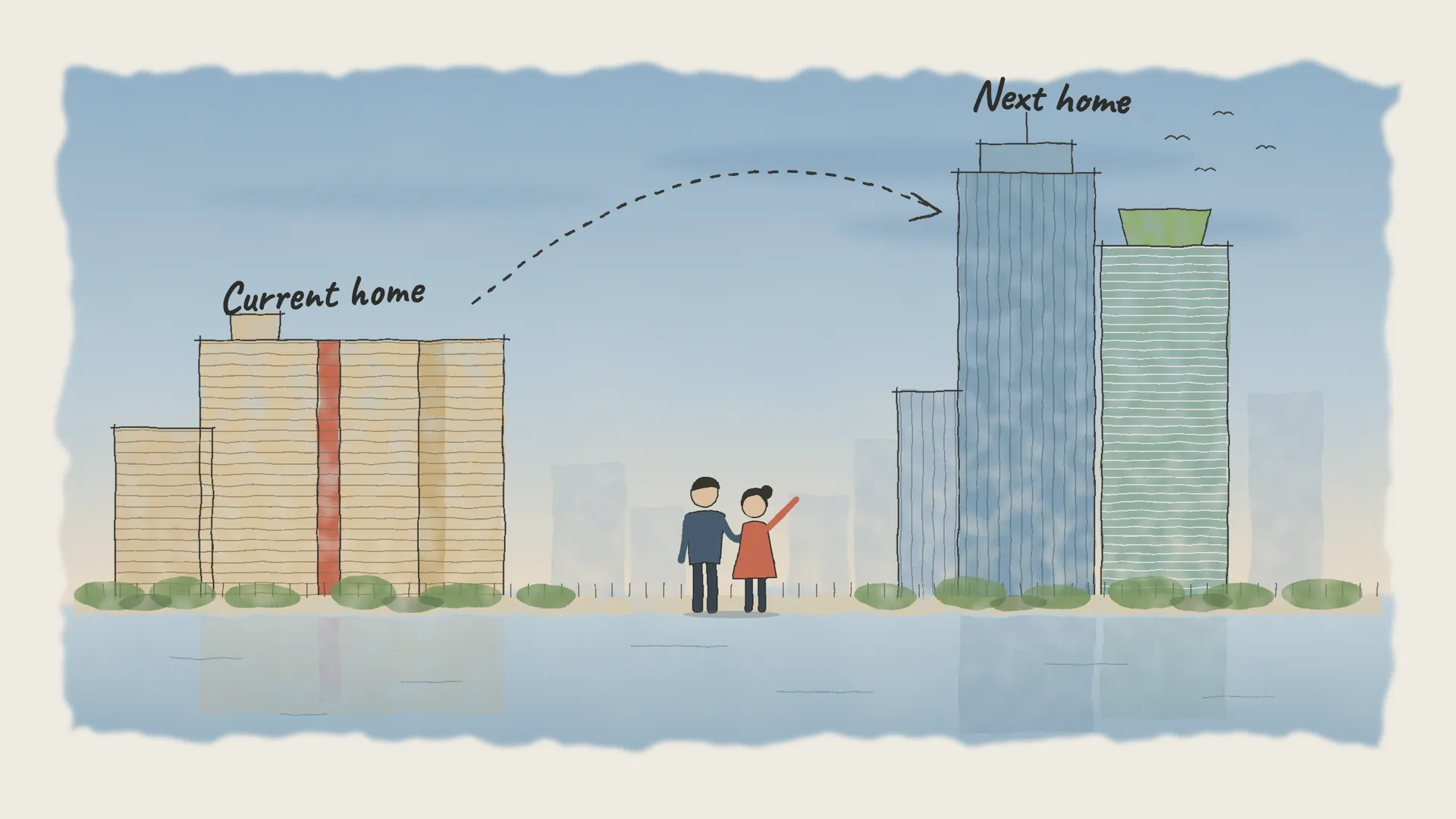
This is the question I am asked most often, and it does not have a universal answer. What it has is a decision rule.
The short answer
When someone asks whether to sell first, what they usually mean is: how do I do this without ending up exposed?
So the useful framing is not which sequence is better in the abstract. It is which sequence leaves you solvent and unhurried if things go slightly wrong — because in a transaction with this many moving parts, something usually does.
You know your number. The property is sold, the loan is repaid, the CPF refund has gone back, and you are looking at an actual bank balance rather than an estimate. Every property you view is assessed against a real budget.
You are also, in most cases, buying as a household that does not own another residential property at the point of purchase — which keeps ABSD out of the picture and keeps your new loan treated as a first housing loan.
Your sale's completion and your new home's completion rarely align neatly, so you may need somewhere to live in between. That means either an interim rental, a stay with family, or negotiating to lease back your old place from the buyer for a short period — which is sometimes possible and sometimes not.
Fact
Once your property sale completes, the CPF you used for it — plus accrued interest — is returned to your CPF account. It can be used again for the next property.
One move. You secure the property you want, at a price you have seen, without a clock running.
That is worth something real, particularly for households with school-going children or anyone who genuinely cannot face moving twice.
The costs are concentrated at the start. You will potentially be holding two residential properties at the moment of purchase, dependent on the timeline of your purchase and ABSD payable upfront on the new purchase. For married couples with at least one Singapore Citizen spouse, a remission may be claimable if their first matrimonial property is sold within the prescribed window — but the money leaves your account first and comes back later, and the conditions have to be met exactly.
Your loan-to-value limit on the new purchase is also lower while the existing housing loan is outstanding, which means more cash and CPF upfront, unless you clear off your existing outstanding loan.
Illustrative only
The figures below are round numbers chosen to simplify a real case study of a consultation that I've done. They are not a market estimate, a valuation, or a quote for your situation.
A 40 year old couple of a combined income of $30,000 owns a flat they believe will sell for $900,000. They still owe $180,000 on the loan. Between them they have used $220,000 of CPF, and accrued interest has built up to roughly $60,000 on top of that. Selling costs come to about $18,000.
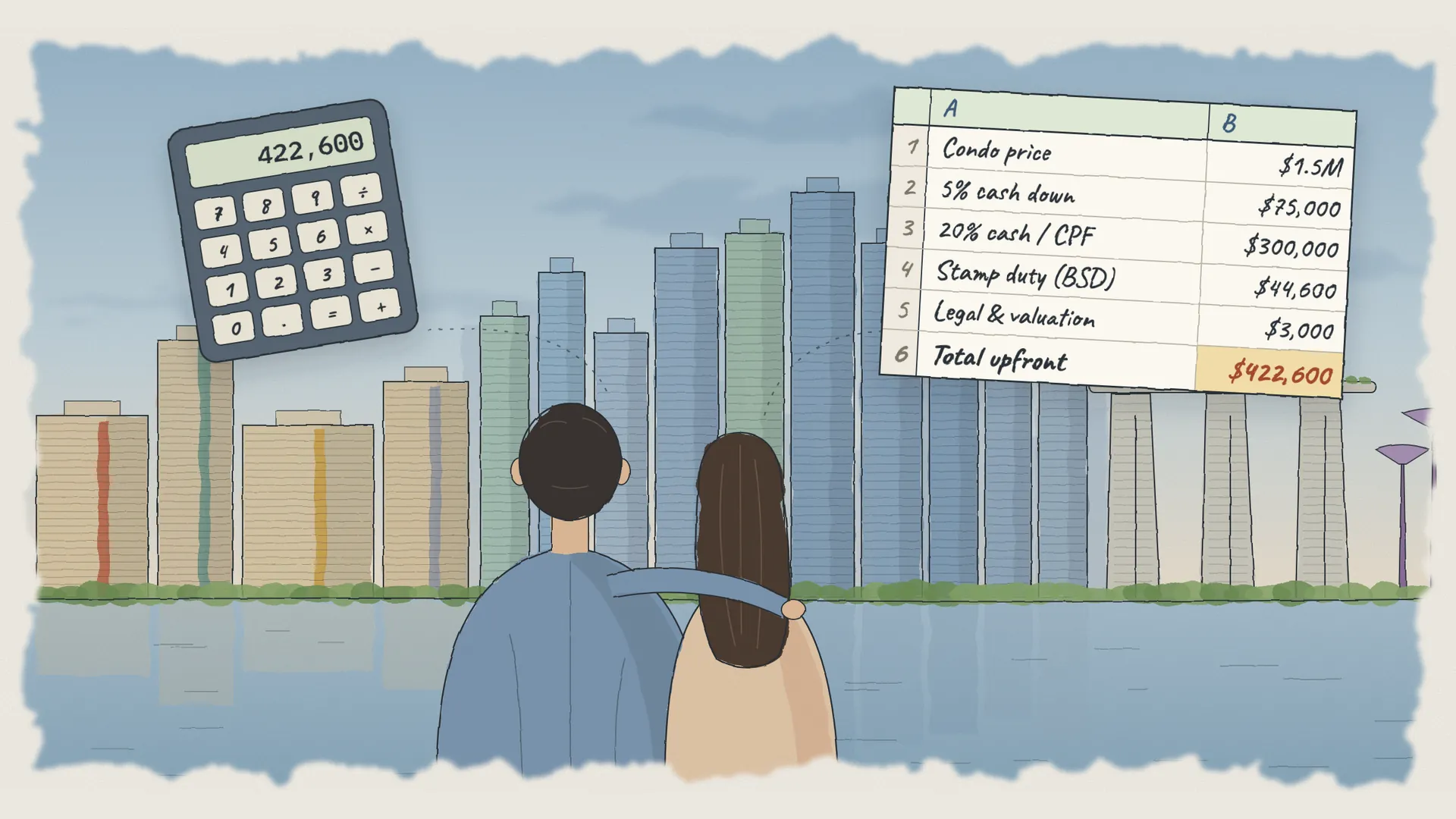
Doing the math: $900,000 less the $180,000 loan leaves $720,000. Refunding $280,000 to CPF leaves $440,000. After selling costs, they have about $422,000 of cash, plus $280,000 sitting in CPF available for the next purchase.
That is a strong position of a combined $702,000 in equity from their current property, without ever reaching into their current savings, if they sell first and purchase later.
On the flip side, had they purchased first, not only do they not have the estimated $702,000 of equity on hand, they would have to fork out 25% in cash for their downpayment for their purchase due to current outstanding loan, ABSD of 20% on their second property.
Putting it in numbers, assuming they are purchasing a $2,500,000 property:
Initial outlay for purchasing first is already $1,219,600.
Rates as at September 2026
The ABSD rate, the minimum cash share of the downpayment and the Buyer's Stamp Duty tiers above are the ones in force when this was written. All three have been revised before. Confirm the current figures with IRAS and your banker before planning against them.
With the numbers laid out, this usually gives upgraders a clearer idea the sequence of their journey.
Decision path
Sell first or buy first?
Work down from your cash buffer, not from your preference. Confirm the current ABSD and remission conditions with IRAS before relying on any of this.
Could you comfortably pay the upfront cost of the new purchase — including ABSD — while still holding your current property?
Upfront cost means downpayment, stamp duties, legal fees and renovation.
No
Sell first.
Buying first without the cash to carry both is how households end up accepting a low offer under time pressure.
Yes
The sale of your property is taking three months longer than expected, and the ABSD remission window is closing. Would you accept a lower price to move it?
No
Sell first, or line up a firm buyer before you commit.
The sale timeline condition for the ABSD remission is non-negotiable.
Yes
Do you specifically need to avoid moving twice?
Yes
Buying first is needed — with all the necessary cost paid upfront first.
Confirm the remission conditions and timelines with your conveyancing lawyer before you exercise any option.
No
Sell first anyway.
The certainty is usually worth more than the convenience.
This is a general decision framework, not advice on your situation. ABSD calculation depends on residency status, marital status, the number of residential properties held and the timeline planned for your sale and purchase.
Last updated 29 September 2026Based on publicly available Singapore property data
Sources & where to verify
Rules, rates and published figures change. Check the current position on the official source before you act on anything here.
New insights, when they're worth sending
Occasional emails when I publish something useful. No listings, no blasts.
Where most people go next from here.
I'd like to measure which articles are actually useful, using Google Analytics and a Meta advertising pixel. Nothing is loaded until you choose, and declining costs you nothing on this site. What these do.